> For the complete documentation index, see [llms.txt](https://docs.webstudio.is/llms.txt). Markdown versions of documentation pages are available by appending `.md` to page URLs; this page is available as [Markdown](https://docs.webstudio.is/university/marketplace.md).
# Marketplace
The Marketplace is integrated into the Builder and offers templates contributed by Webstudio and the community.
See [Webstudio Templates](https://webstudio.is/marketplace/templates) or head over to the Builder to view templates.
## Types of templates
### **Pages**
Marketplace page templates are pre-designed single or multi-page layouts for entire pages. Upon selection, a new page will be inserted into your Project.
For reusable page blueprints inside a single project, use [Page templates](/university/foundations/page-templates.md).
### **Integrations**
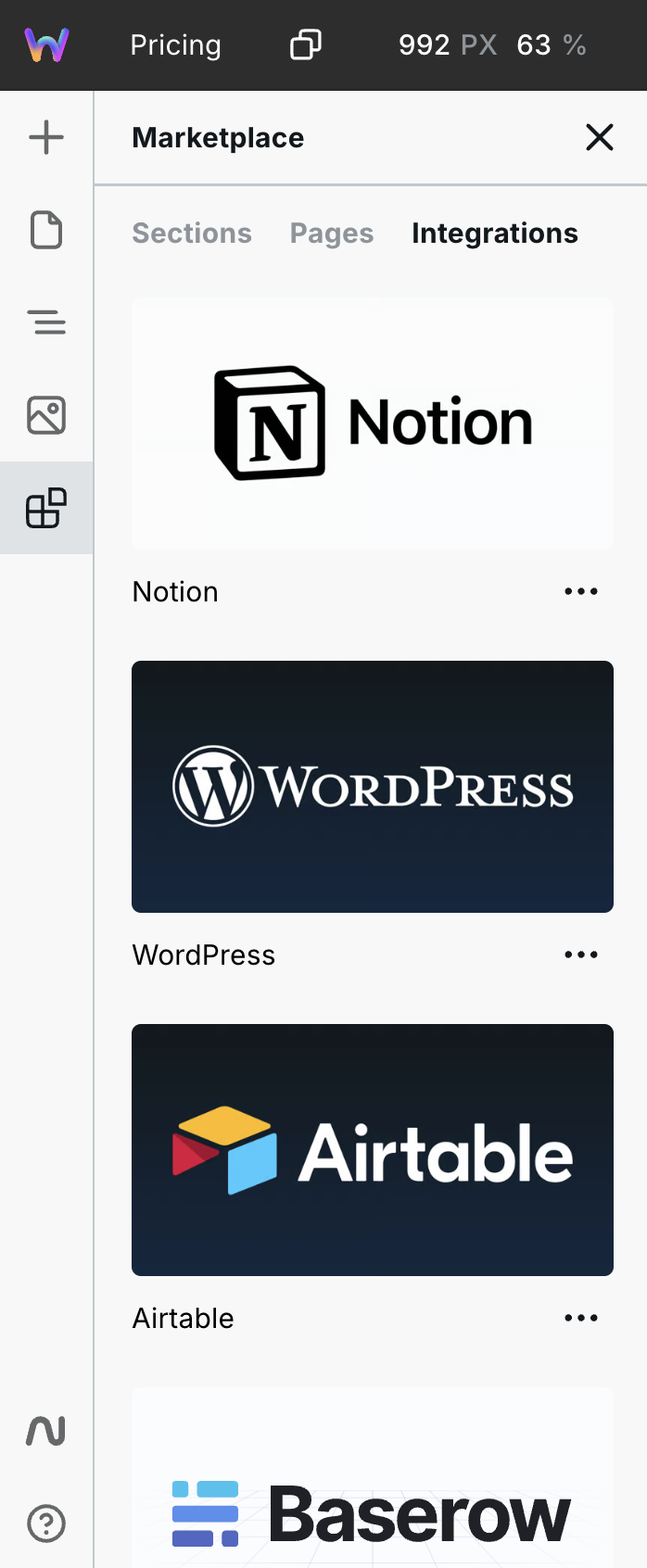
Integration templates are [pages](#pages) with preconfigured [Resources](/university/foundations/variables.md#resource), such as Airtable, Notion, Ghost, Baserow, and more.
Blog templates, for example, typically include pages like:
* Posts
* Post
* Author
* Tag
* Sitemap
Integration templates are typically unstyled or minimally styled, allowing you to apply your own design while providing the backend API connections.
### **Sections**
Section templates are pre-designed layouts for quickly creating pages from sections. Upon selection, the section is inserted into the current page.
## Webflow Ecosystem Compatibility
Webstudio supports templates, component libraries, and projects from the Webflow ecosystem, allowing you to copy from Webflow and paste into Webstudio. Learn more about [Copy Paste](/university/foundations/copy-paste/webflow.md).
## Contributing to the Marketplace
You can contribute free or paid templates by creating a project and submitting it for review.
Learn about about [contributing to the Marketplace](/contributing/marketplace.md).
## Token Conflict Resolution
When inserting marketplace templates that use design tokens, Webstudio automatically detects if any token names conflict with tokens already used in your project.
For example, if a template defines a token called `--primary-color` with value `#FF0000`, but your project already has a `--primary-color` token with value `#0000FF`, Webstudio will display a conflict resolution dialog.
### Resolving Conflicts
When conflicts are detected, you can choose how to handle them:
* **Rename template tokens** - Template tokens are automatically renamed (e.g., `--primary-color-2`) to avoid conflicts
* **Overwrite existing tokens** - Replace your existing tokens with the template's values (use with caution)
* **Keep existing tokens** - The template will use your existing token values instead
This ensures marketplace templates integrate smoothly into your projects without breaking existing designs.
## Related
* [Webstudio Templates](https://webstudio.is/marketplace/templates) – Browse all available templates
* [Page templates](/university/foundations/page-templates.md) – Create reusable page blueprints inside a project
* [Contributing to the Marketplace](/contributing/marketplace.md) – Submit your own templates
* [Craft](/university/craft.md) – The standard for building marketplace templates
* [Copy-Paste from Webflow](/university/foundations/copy-paste/webflow.md) – Import templates from Webflow
* [Dashboard](/university/foundations/dashboard.md) – Manage your projects and workspaces
---
# Agent Instructions
This documentation is published with GitBook. GitBook is the documentation platform designed so that both humans and AI agents can read, navigate, and reason over technical content effectively. Learn more at gitbook.com.
## Querying This Documentation
If you need additional information that is not directly available in this page, you can query the documentation dynamically by asking a question.
Perform an HTTP GET request on the current page URL with the `ask` query parameter, and the optional `goal` query parameter:
```
GET https://docs.webstudio.is/university/marketplace.md?ask=&goal=
```
`ask` is the immediate question: it should be specific, self-contained, and written in natural language.
`goal` is optional and describes the broader end goal you are ultimately trying to accomplish on behalf of the user. GitBook uses it to tailor the answer towards what is most useful for that goal.
The response will contain a direct answer to the question and relevant excerpts and sources from the documentation.
Use this mechanism when the answer is not explicitly present in the current page, you need clarification or additional context, or you want to retrieve related documentation sections.