> For the complete documentation index, see [llms.txt](https://docs.webstudio.is/llms.txt). Markdown versions of documentation pages are available by appending `.md` to page URLs; this page is available as [Markdown](https://docs.webstudio.is/university/foundations/modes.md).
# Modes
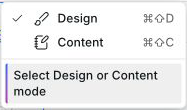
Modes change the Builder’s behavior, such as previewing your site without distractions.
There are three modes:
* [Design](#design)
* [Content](#content)
* [Preview](#preview)
You can change modes in the Top Bar or via [keyboard shortcuts](/university/foundations/shortcuts.md) if you have sufficient [permissions](/university/foundations/share-links.md#types-of-share-links).
Additionally, you can open any project in [Safe Mode](#safe-mode), which disables script execution for security and troubleshooting purposes.
## Design
Design mode provides the full power of the Builder. For example, you can add and style components.
## Content
Content mode tailors the builder’s features to editor tasks like updating text and images, and adding templates to designer-specified regions. Text and supported props are editable only inside [Content Blocks](/university/core-components/content-block.md); everything outside them is read-only. This mode is ideal for team members and clients.
### Allowed actions
In Content mode, the following actions can be performed:
* Edit text content (e.g., paragraphs, headings, links, etc.) inside Content Blocks
* Add and edit links within text inside Content Blocks
* Upload and change images inside Content Blocks when their props are available in Content mode
* Insert instances of templates to designer-specified regions called [Content Blocks](/university/core-components/content-block.md)
* Edit MDX article fields and bodies inside connected Content Blocks, with changes saved back to the source file
* Create and edit entries in [content collection folders](/university/foundations/content-engine.md#make-the-folder-a-content-collection)
* Create pages from existing [Page templates](/university/foundations/page-templates.md), if the designer provided them
* Edit safe page settings: page name, static path, title, description, search visibility, language, social image, and custom metadata
* Publish the site (optional [permission](/university/foundations/share-links.md#types-of-share-links))
Content mode keeps structural and developer-oriented settings protected. Editors cannot create dynamic paths, change redirects, status codes, document type, authentication, page variables, or the page templates themselves.
### For designers/developers
As the website designer/developer, Content mode helps you strike the balance between creating a professional website while also letting your clients/team members edit it without them breaking it or deviating from the design system.
{% embed url="" %}
Here’s what you need to know:
* You can try the Content mode by going to the Top Bar and changing modes.
* Users on the Pro tier can create a [Share link](/university/foundations/share-links.md) with “Content” permission
* Editors can perform [these actions](#allowed-actions)
* You can create templates that editors can insert with [Content Blocks](/university/core-components/content-block.md)
* You can connect MDX files to Content Blocks and configure collection folders so editors can create and edit complete articles visually
* You can create [Page templates](/university/foundations/page-templates.md) that editors can use to create new pages
* Editors can update safe page metadata, but dynamic routes, redirects, authentication, document type, and status-code logic remain under designer control
#### Creating a Content mode share link
1. Go to **Share** in the top bar
2. Create a new share link
3. Check "Content mode" option
4. Optionally enable/disable publish permission for the client
#### Testing Content mode
You can quickly switch to Content mode using the mode dropdown arrow next to Design in the top bar — useful for testing what clients will see before sharing the link.
#### Content Block templates
Content Block templates cannot be deleted by editors. Even if all instances of a template are removed, the template itself remains available for editors to add again. Make sure templates include complete styling since editors don't have access to the Style panel.
### For editors
With Content mode, you can dive right in and edit the website without feeling overwhelmed or risking any changes to the site that could cause issues.
{% embed url="" %}
Here’s what you need to know:
* You can click directly on the canvas to update text inside a Content Block. Text outside a Content Block is read-only. Want to update a title to the latest promotion? Click, type, done.
Editing content on the canvas
* Some items inside a Content Block may have settings, like images. Clicking on an image will display the settings on the right. There, you can upload a new image. Just be sure to fill in the field called “Alt” describing the image so visually impaired people can consume your site.
The image can be replaced in the Settings Panel
* The designer must include [Content Blocks](/university/core-components/content-block.md#content-block-in-content-mode) for content you need to change. These are the regions where you can edit content and add templates the designer provided. See [Content Block](/university/core-components/content-block.md) for more information.
* In a [content collection](/university/foundations/content-engine.md#make-the-folder-a-content-collection), choose **New entry** to create an article with the form provided by the designer. Use **Entry settings** to edit its fields, **Edit file** to edit its source, or **Open on canvas** to edit the complete article on its configured dynamic page.
* If the designer provided [Page templates](/university/foundations/page-templates.md), you can create new pages from them and edit page details like name, path, SEO title, description, language, social image, and custom metadata.
* Changes save in real time, but you must publish them before they go live. Select **Publish** in the top bar, choose the destinations, and publish. **Publish** may be unavailable if the designer did not grant publishing permission.
## Preview
Preview mode hides editing capabilities so you can browse your website. Use it to test navigation, interactions, and responsive behavior on every breakpoint.
## Safe Mode
Safe mode is a security and troubleshooting feature that prevents all scripts from executing in your project. This is useful when:
* You suspect a script is causing issues or slowing down the builder
* You need to troubleshoot problems that might be caused by custom JavaScript
* You want to safely inspect a project before running potentially harmful code
* You're reviewing a marketplace template or imported project
### How to Enable Safe Mode
From the dashboard:
1. Right-click (or long press on mobile) on a project
2. Select **Open in safe mode** from the menu
When safe mode is active, you'll see a shield icon in the top bar indicating that script execution is disabled.
### What Safe Mode Disables
* All JavaScript in HTML Embed components
* Custom scripts added to the project
* Third-party scripts (analytics, widgets, etc.)
### What Still Works
* All styling and layout features
* Component rendering
* Text and image editing
* Building and publishing
{% hint style="info" %}
Safe mode only affects the builder preview. Published sites always run scripts normally, regardless of whether you edited the project in safe mode.
{% endhint %}
## Related
* [Share links](/university/foundations/share-links.md) – Create Content mode share links for clients
* [Content Block](/university/core-components/content-block.md) – Define editable regions for Content mode
* [Shortcuts](/university/foundations/shortcuts.md) – Keyboard shortcuts to switch modes quickly
* [Anatomy of the Webstudio builder](/university/foundations/anatomy-of-the-webstudio-builder.md) – Overview of the Builder interface
---
# Agent Instructions
This documentation is published with GitBook. GitBook is the documentation platform designed so that both humans and AI agents can read, navigate, and reason over technical content effectively. Learn more at gitbook.com.
## Querying This Documentation
If you need additional information that is not directly available in this page, you can query the documentation by asking a question.
Perform an HTTP GET request on the following URL with the `ask` and `goal` query parameters:
```
GET https://docs.webstudio.is/university/foundations/modes.md?ask=&goal=
```
`ask` is the immediate question: it should be specific, self-contained, and written in natural language.
`goal` is what the user is ultimately trying to achieve, the reason they need the answer. Sharing it helps GitBook give you a better, more relevant answer. A goal is most helpful when it describes the outcome the user wants rather than restating the question. For example, with `ask=how do I create an API token`, a goal like `automate deployments from our CI pipeline` lets GitBook tailor the answer to that use case.
The response will contain a direct answer to the question and relevant excerpts and sources from the documentation.
Use this mechanism when the answer is not explicitly present in the current page, you need clarification or additional context, or you want to retrieve related documentation sections.