> For the complete documentation index, see [llms.txt](https://docs.webstudio.is/llms.txt). Markdown versions of documentation pages are available by appending `.md` to page URLs; this page is available as [Markdown](https://docs.webstudio.is/university/core-components/markdown-embed.md).
# Markdown Embed
Markdown Embed converts Markdown to HTML and enables styling it.
## Why Markdown Embed is needed
Some APIs (or users) provide rich text in Markdown format, which can't be rendered in the web browser. Markdown Embed converts Markdown to HTML and enables applying styles to the various tags contained within HTML.
## How to use Markdown Embed
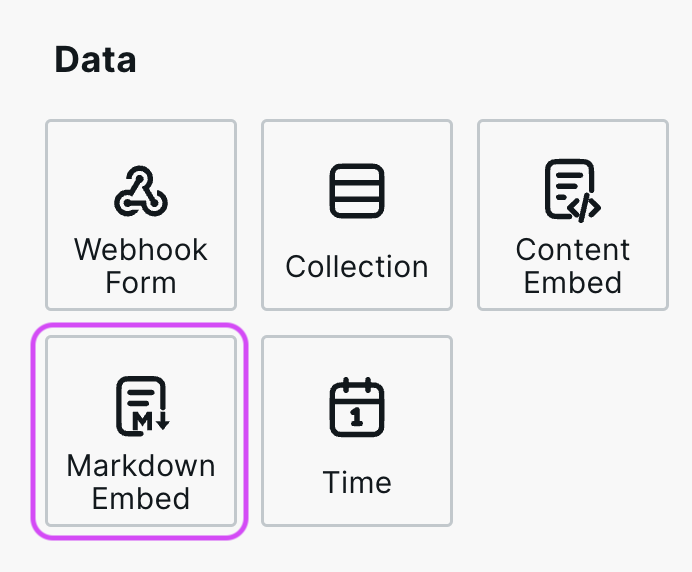
Markdown Embed is located in Components > Data.
### 1. Add Markdown
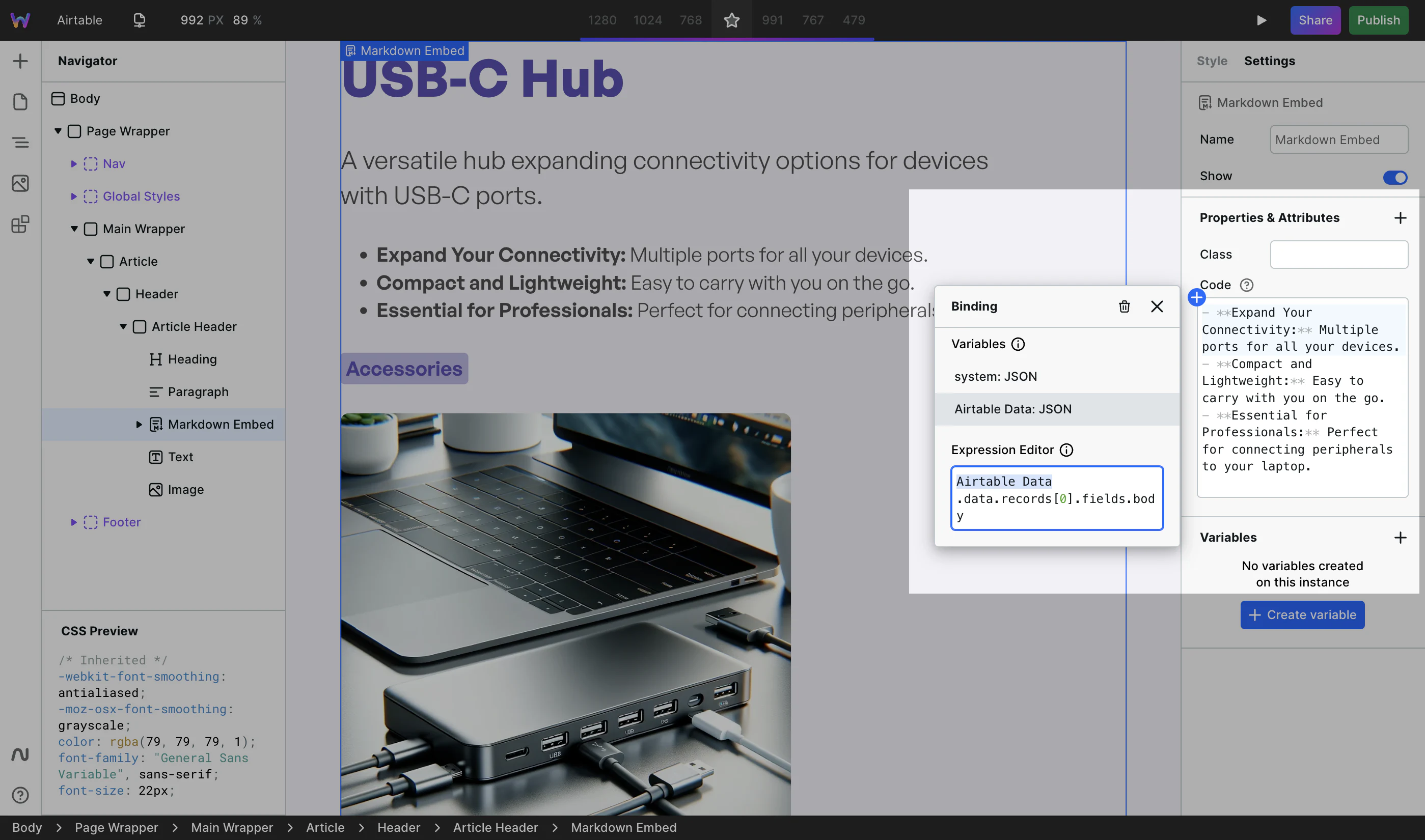
Once added to the canvas, the right panel will show a Code field. You can either add Markdown directly to it or, more commonly, bind Markdown to it from a Resource.
CMS data bound to Markdown Embed Code
### 2. Style
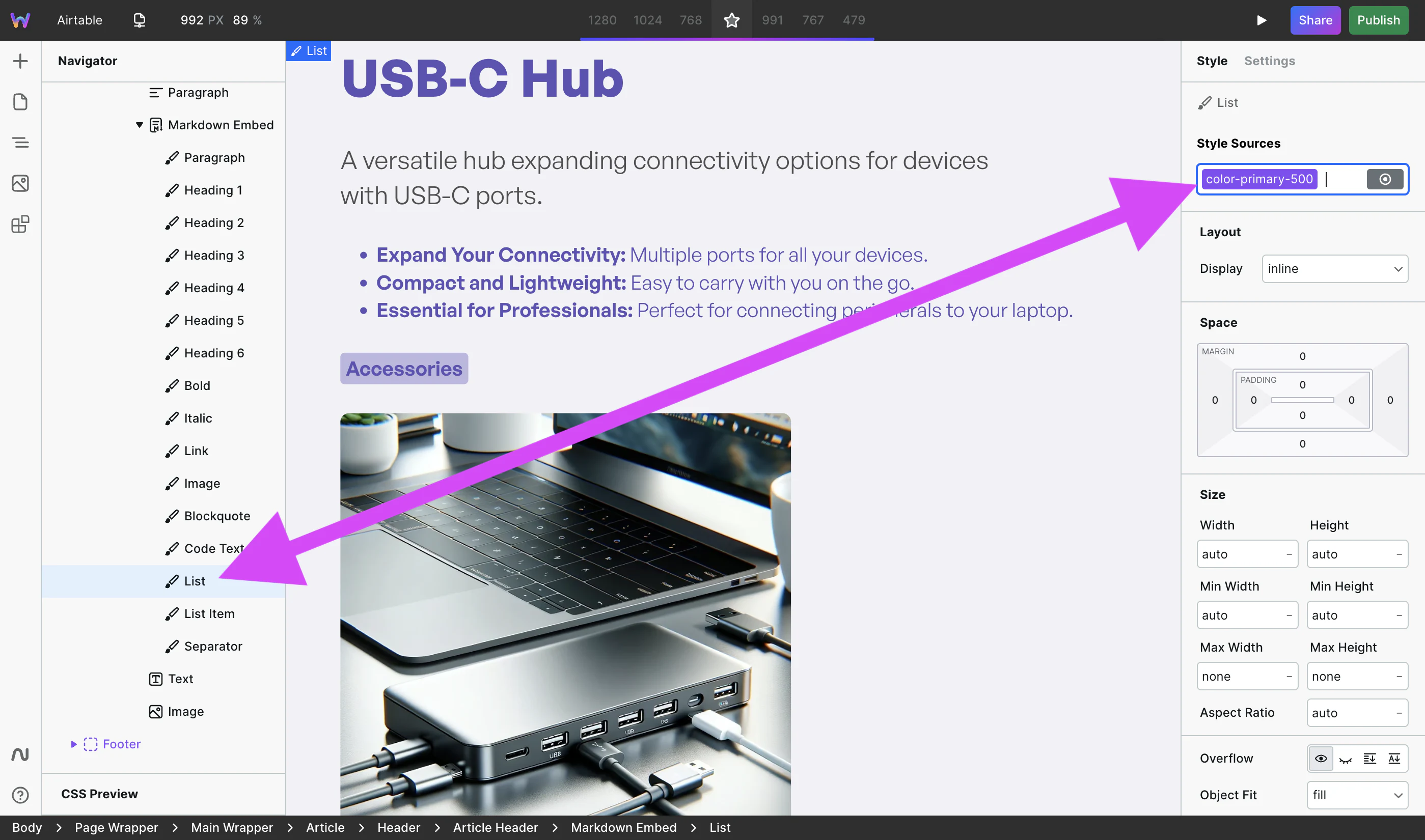
In the Navigator, Markdown Embed has various HTML tags nested. Expand Markdown Embed, and you’ll see tags such as Heading 1, Link, Image, and much more.
List selected and styled
Styles applied to each of these tags will apply to all occurrences of that tag within the Markdown Embed. For example, if you apply a border on the Image tag, then all images contained within the HTML will have a border.
## GitHub-style alerts
Use GitHub-style alerts to call attention to notes, tips, important information, warnings, and cautions:
```markdown
> [!NOTE]
> Add helpful context here.
> [!WARNING]
> Explain what readers should be careful about.
```
Write the alert type in uppercase at the start of a blockquote. Markdown Embed supports `NOTE`, `TIP`, `IMPORTANT`, `WARNING`, and `CAUTION`. You can use links, lists, code, and other Markdown inside an alert.
Select **Alert** to style every alert, or a type-specific descendant such as **Warning alert** to style one alert type. Markdown Embed renders the same `data-state` values as the standalone [Alert component](/university/core-components/alert.md).
## Image handling
Webstudio optimizes images contained in Markdown with the same responsive image pipeline as the [Image component](/university/core-components/image.md#optimize). It generates the appropriate `srcset` and `sizes` attributes and lazy-loads images by default.
Data URL images are served as-is without optimization.
## Similar components
{% content-ref url="/pages/rHKKkqfgRmjo89BY2EvK" %}
[HTML Embed](/university/core-components/html-embed.md)
{% endcontent-ref %}
{% content-ref url="/pages/2pY5IGDefvOgBTofmVWY" %}
[Content Embed](/university/core-components/content-embed.md)
{% endcontent-ref %}
## Related
* [Content Embed](/university/core-components/content-embed.md) – Render rich text/HTML
* [Alert](/university/core-components/alert.md) – Add and style standalone callouts
* [HTML Embed](/university/core-components/html-embed.md) – Custom HTML code
* [Collection](/university/core-components/collection.md) – Loop through CMS data
---
# Agent Instructions
This documentation is published with GitBook. GitBook is the documentation platform designed so that both humans and AI agents can read, navigate, and reason over technical content effectively. Learn more at gitbook.com.
## Querying This Documentation
If you need additional information that is not directly available in this page, you can query the documentation dynamically by asking a question.
Perform an HTTP GET request on the current page URL with the `ask` query parameter, and the optional `goal` query parameter:
```
GET https://docs.webstudio.is/university/core-components/markdown-embed.md?ask=&goal=
```
`ask` is the immediate question: it should be specific, self-contained, and written in natural language.
`goal` is optional and describes the broader end goal you are ultimately trying to accomplish on behalf of the user. GitBook uses it to tailor the answer towards what is most useful for that goal.
The response will contain a direct answer to the question and relevant excerpts and sources from the documentation.
Use this mechanism when the answer is not explicitly present in the current page, you need clarification or additional context, or you want to retrieve related documentation sections.