> For the complete documentation index, see [llms.txt](https://docs.webstudio.is/llms.txt). Markdown versions of documentation pages are available by appending `.md` to page URLs; this page is available as [Markdown](https://docs.webstudio.is/university/foundations/share-links.md).
# Share links
Share links enable you to share your Webstudio Project with other people, set permissions, and create cloneable project copies.
**Use cases:**
* Providing one-off access to a site
* Cloning the Project to another Webstudio account
* Sharing your Project to get support
* [Selling templates](https://docs.webstudio.is/contributing/marketplace.md#selling-templates) (i.e., using share links to deliver the template upon payment)
* Creating your own marketplace of templates
{% hint style="info" %}
For ongoing collaboration, invite people to a workspace from the [Dashboard](https://docs.webstudio.is/university/foundations/dashboard.md#workspaces). For moving a project to another workspace or transferring it to another user, use the project menu in the Dashboard.
{% endhint %}
{% hint style="warning" %}
Share links should be treated like access keys. Anyone who gets the link can use it according to the permissions you set, so avoid sending share links through unsecured channels. Workspace membership invites are more secure for ongoing collaboration because access is tied to the recipient's Webstudio account and accepted from their Dashboard notifications.
{% endhint %}
## Cloning projects
When you share a project with **View** permission (or higher), recipients can clone the project to their own Webstudio account:
1. Create a Share link with at least **View** permission
2. Send the link to the recipient
3. They open the link and click the **Clone** button in the Builder
4. The project is copied to their account
{% hint style="info" %}
**Pro tip:** Use this feature to build a template marketplace. Create templates, share View links, and let users clone them into their accounts.
{% endhint %}
## Adding share links
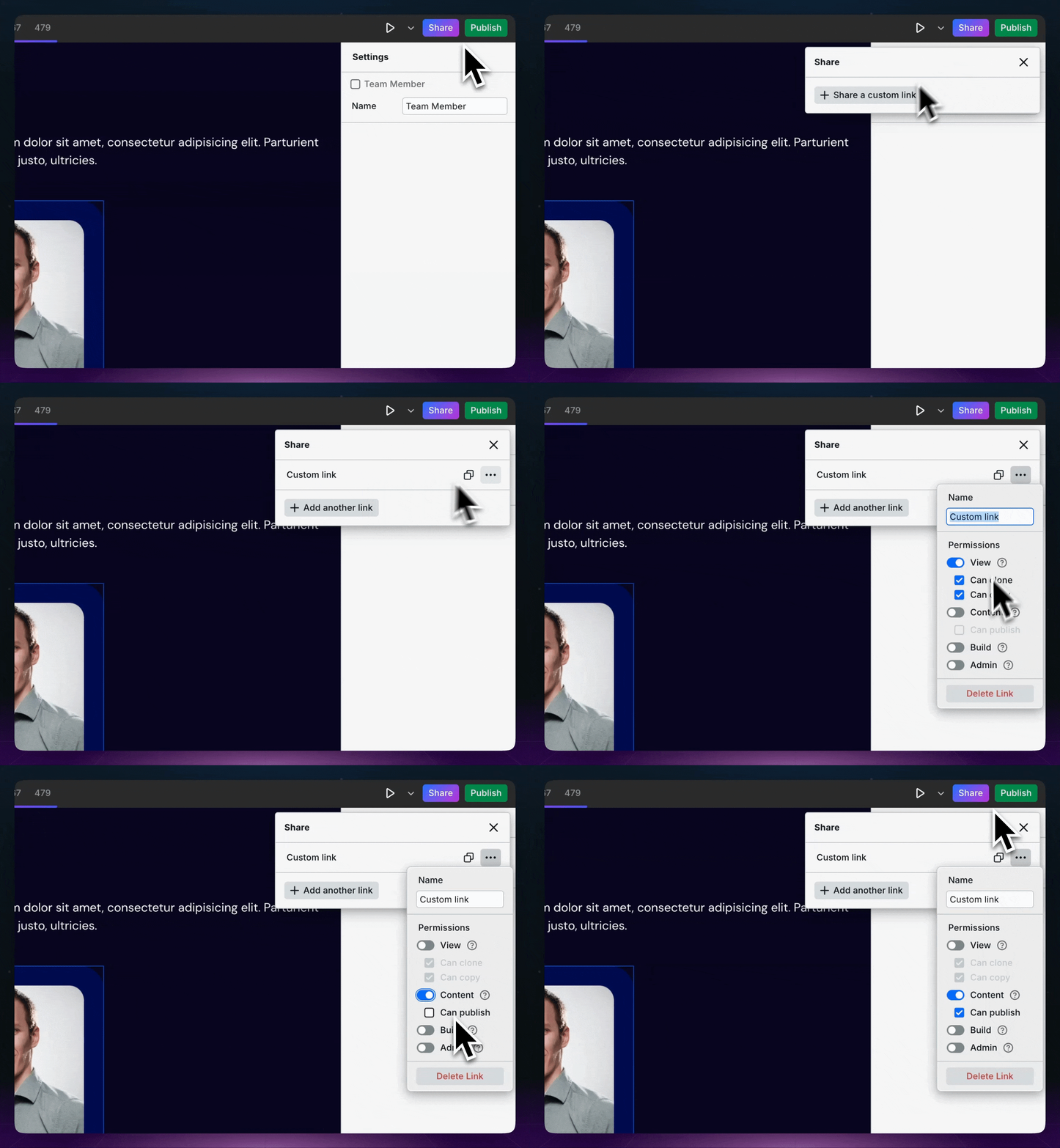
Share links are created in the Top Bar in the Share dialog.
{% hint style="success" %}
There is no limit to how many share links you can add.
{% endhint %}
## Types of share links
| Type | Is paid feature | Permissions |
| ------- | --------------- | ----------------------------------------------------------------------------------------------------------------------------------------- |
| View | No |
View
Copy instances (Pro users can disable copying)
Clone the Project (Pro users can disable cloning)
|
| Content | Yes |
Edit content only, such as text, images, and predefined components
Clone the Project
Publish (optional)
|
| Build | No |
Make any changes
Clone the Project
Can't publish
|
| Admin | Yes |
Make any changes
Clone the Project
Publish
|
## Working with clients
When building a site for someone else, you may want to give them a cloneable copy, transfer the original project from the Dashboard, or provide limited editing access.
### Option 1: Share a cloneable copy
Create a new share link with cloning permissions (see [Types of share links](#types-of-share-links)). Then, send the link to your client so they can clone the Project into their Webstudio account.
{% hint style="warning" %}
If you are on a paid tier, it is tied to your account or workspace, not to the cloned project. The recipient needs a plan that covers any paid features or limits used by their copy.
{% endhint %}
If you plan to continue working on the website after they clone it, they can invite you to their workspace or create a Share link and send it to you.
### Option 2: Content mode
The Pro tier lets you create share links with the Content permission, allowing recipients to edit content inside [Content Blocks](https://docs.webstudio.is/university/core-components/content-block.md) without designer-oriented features like the Style Panel. Content outside Content Blocks remains read-only.
To provide this, create a Share link, toggle “Content”, and send this link to your client.
See [Modes](https://docs.webstudio.is/university/foundations/modes.md) to learn more about this.
## Related
* [Publishing & custom domains](https://docs.webstudio.is/university/foundations/publishing-and-custom-domains.md) – Deploy your site and connect custom domains
* [Modes](https://docs.webstudio.is/university/foundations/modes.md) – Switch between Design, Content, and Preview modes
* [Project settings](https://docs.webstudio.is/university/foundations/project-settings.md) – Configure project-wide settings
* [Content Block](https://docs.webstudio.is/university/core-components/content-block.md) – Create editable regions for Content mode users
---
# Agent Instructions
This documentation is published with GitBook. GitBook is the documentation platform designed so that both humans and AI agents can read, navigate, and reason over technical content effectively. Learn more at gitbook.com.
## Querying This Documentation
If you need additional information that is not directly available in this page, you can query the documentation by asking a question.
Perform an HTTP GET request on the following URL with the `ask` and `goal` query parameters:
```
GET https://docs.webstudio.is/university/foundations/share-links.md?ask=&goal=
```
`ask` is the immediate question: it should be specific, self-contained, and written in natural language.
`goal` is what the user is ultimately trying to achieve, the reason they need the answer. Sharing it helps GitBook give you a better, more relevant answer. A goal is most helpful when it describes the outcome the user wants rather than restating the question. For example, with `ask=how do I create an API token`, a goal like `automate deployments from our CI pipeline` lets GitBook tailor the answer to that use case.
The response will contain a direct answer to the question and relevant excerpts and sources from the documentation.
Use this mechanism when the answer is not explicitly present in the current page, you need clarification or additional context, or you want to retrieve related documentation sections.